

PREFACE
The information contained within this manual is being offered as a go-to reference in order to further reinforce and enhance your knowledge of the Equi-Taping® Methodology. The content in this guide is designed as an information source only and does not replace the advice of a trained Certified Equi-Taping® Practitioner or diagnosis from a Doctor of Veterinary Medicine.
Each example is purely a fictitious representation of an actual taping using the Equi-Taping® Methodology. Each example represents only one possible taping strategy out of many that could be considered a viable taping solution to the assessment being presented.
LEGAL NOTICE
Equi-Tape® and Equi-Taping® instructions are not a substitute for professional veterinary advice or that of a qualified taping practitioner. Warranties and remedies are limited to product replacement value. Equi-Tape® and Equi-Taping® are registered trademarks of The Horse In Motion Inc. and exclusively licensed to RS Bioceuticals ©2015 Protected by International Copyright Laws. ALL RIGHTS RESERVED Duplication of any part of this reference guide is strictly prohibited.
|
|
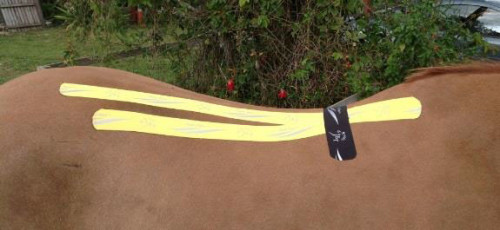 ASSESSMENT: Back is sore to palpation (in spasm) from overworked muscles ASSESSMENT: Back is sore to palpation (in spasm) from overworked muscles
APPLICATION OBJECTIVE: Therapeutic (while in training). APPLICATION GOAL: Muscle Relaxation. This taping can be helpful when used during training (under tack) to aid horse’s back muscles in work. APPLICATION TECHNIQUE: Use two long 2”-wide strips of Equi-Tape®. Lower horse’s head so back muscles are stretched. Begin by placing first tape at the withers using no stretch for the first 2-3”. Stretch the tape slightly as you follow along the muscle as shown. Lay down the last 2-3” of tape with no stretch. Apply second piece as shown. The black piece of tape is applied as an anchor for the application – tear paper backing in the center and apply with no stretch. CONSIDERATIONS: Continue training with tape under tack. Leave tape with trainer. Re-tape if application lifts. |
|
|
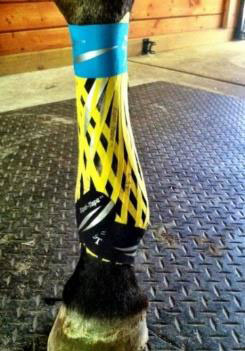 ASSESSMENT: Swelling, pain and inflammation of fetlock and lower leg. Trauma related. ASSESSMENT: Swelling, pain and inflammation of fetlock and lower leg. Trauma related.
APPLICATION OBJECTIVE: Therapeutic Taping APPLICATION GOAL: Circulation taping. Used when swelling and inflammation is evident. Effective in relieving pain associated with fluid stasis, and aids in improving circulation of blood and lymph in swollen tissue which speeds healing; particularly effective when the horse exhibits tenderness to palpation. APPLICATION TECHNIQUE: Use two or more long 2” fan strips and apply in basket weave pattern. Fan strips should have 5-6 tails. Apply initial ends toward nearest lymph nodes so as to direct fluid flow in that direction. Use paper-off to mild stretch. (You can continue strips ending on CONSIDERATIONS: Turn out with wraps, standing bandages at night, re-check/re-apply tape in 3-5 days. Follow-up with an ankle support taping when swelling is diminished if desired. *Poultice can be used over tape at night if desired and rinsed off the next day with water. |
|
|
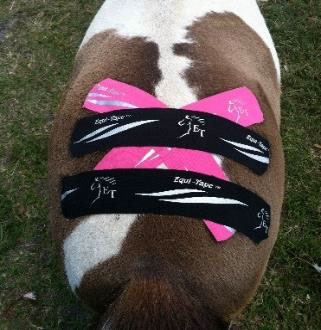 ASSESSMENT: Weak or sore Sacroiliac joints or ligaments. ASSESSMENT: Weak or sore Sacroiliac joints or ligaments.
APPLICATION OBJECTIVE: Therapeutic/Corrective/Recovery APPLICATION GOAL: Joint/Ligament Support. This is a very basic but effective joint stability and support taping used in adding support to the sacroiliac joints. This taping can aid in decreasing joint swelling and inflammation. APPLICATION TECHNIQUE: Apply 2 single strip pieces (pink) diagonally as shown by tearing paper backing in the center of each piece. Place the pieces diagonally to crisscross both SI joints with moderate stretch in the center and no stretch on the last 2-3 inches of each end. Lay down two additional parallel pieces of Equi-Tape® (black), across both SI joints, again with moderate stretch in the center and no stretch on the last 2-3 inches at the ends. CONSIDERATIONS: Leave tape on 3-5 days, re-tape if application lifts. Can leave tape along with instructions and picture of taping with owner. |
|
|
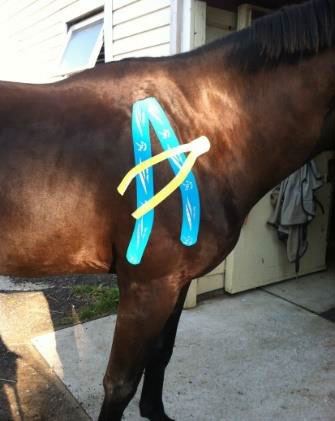 ASSESSMENT: Sore or weak shoulder muscles ASSESSMENT: Sore or weak shoulder muscles
APPLICATION OBJECTIVE: Athletic Training/Rehab APPLICATION GOAL: Muscle Assist. This taping can be helpful when used during training to aid horse’s shoulder muscles in work. This taping can be effective in relieving weakness or soreness during and/or after exercise; particularly effective when your horse exhibits tenderness to palpation APPLICATION TECHNIQUE: Begin by measuring two single strips (blue) and apply them as shown with mild stretch. Note that shoulder tapings have quite a bit of variation in their exact placement depending on the muscle groups targeted for taping. The optional yellow split strip with 2 tails can be added as a spot taping circumventing an area you desire to decompress, such as a trigger point, or an area with greater palpation tenderness. These strips should be applied using mild stretch. CONSIDERATIONS: Leave tape on for several days, re-tape if application lifts. Can leave tape along with instructions and picture of taping with owner. |
|
|
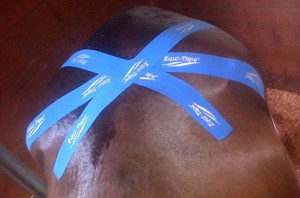 ASSESSMENT: Sacroiliac pain with lumbar spine facet joint irritation, bilaterally. ASSESSMENT: Sacroiliac pain with lumbar spine facet joint irritation, bilaterally.
APPLICATION OBJECTIVE: Therapeutic/ corrective/ recovery APPLICATION GOAL: To reduce pain, decrease compression of the area. APPLICATION TECHNIQUE: Multiple single strip tapes applied to relieve pressure over the sacroiliac joints while assisting with a posterior pelvic tilt to increase lumbar joint space. CONSIDERATIONS: Leave tape on 3 to 4 days before reassessment. |
|
|
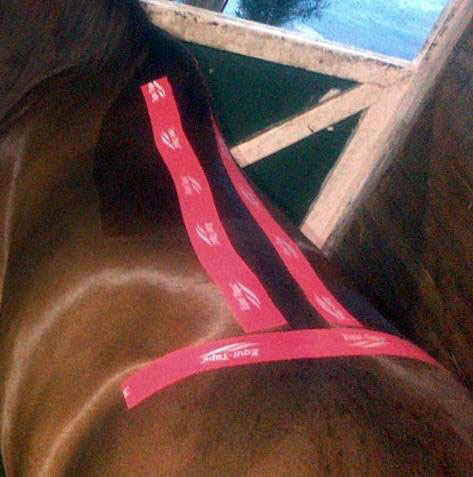 ASSESSMENT: Severe fascial tightness over the back. ASSESSMENT: Severe fascial tightness over the back.
APPLICATION OBJECTIVE: Therapeutic/ corrective/ recovery APPLICATION GOAL: To reduce tension in the fascia, decrease pain, encourage movement of the fascia. APPLICATION TECHNIQUE: 2 single strips on either side of the spine using “stretch & release” and 1 single strip over the lumbosacral joint. CONSIDERATIONS: Tape can be removed if the horse seems uncomfortable. If trainer reports no problems, leave tape on until morning but remove before riding |
|
|
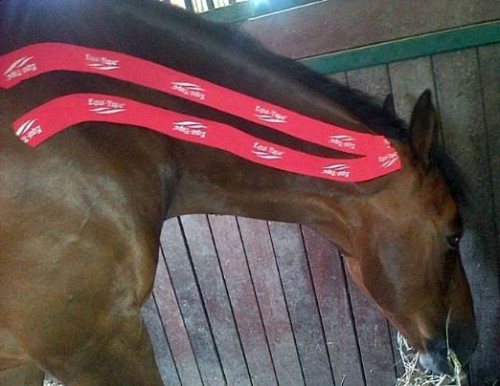 ASSESSMENT: One sided hypertonic musculature resulting in a c-curve of the cervical spine. ASSESSMENT: One sided hypertonic musculature resulting in a c-curve of the cervical spine.
APPLICATION OBJECTIVE: Therapeutic/ corrective/ recovery APPLICATION GOAL: To increase relaxation of the muscle and decrease stiffness. APPLICATION TECHNIQUE: 2 single strips applied with mild stretch. CONSIDERATIONS: Remove before riding and retape after a reassessment in 3 to 4 days. |
|
|
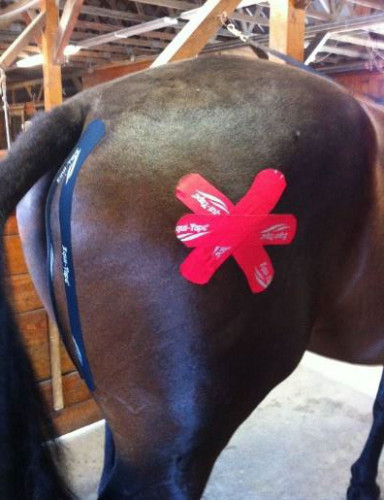 ASSESSMENT: Hip bursitis with bilateral areas of edema over each hip joint. Hypotonic right Semimembranosus and Semitendinosus muscles. ASSESSMENT: Hip bursitis with bilateral areas of edema over each hip joint. Hypotonic right Semimembranosus and Semitendinosus muscles.
APPLICATION OBJECTIVE: Therapeutic and athletic. APPLICATION GOAL: Localized decompression and muscle assist APPLICATION TECHNIQUE: Star and two single strips CONSIDERATIONS: Horse to remain in work, tape remaining on until it comes off; re-evaluate and reapply at the next appointment. Call with any questions. No contraindications. |
|
|
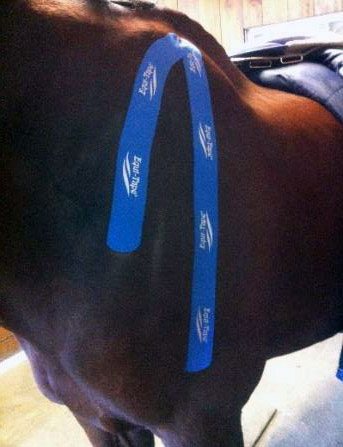 ASSESSMENT: Hypotonic left Supraspinatus and Infraspinatus muscles. ASSESSMENT: Hypotonic left Supraspinatus and Infraspinatus muscles.
APPLICATION OBJECTIVE: Athletic APPLICATION GOAL: Support muscle and increase muscle usage. APPLICATION TECHNIQUE: Two single strips for muscle facilitation CONSIDERATIONS: Horse to remain in work, tape remaining on until it comes off; reapply as needed and demonstrated. Call with any questions. No contraindications. |
|
|
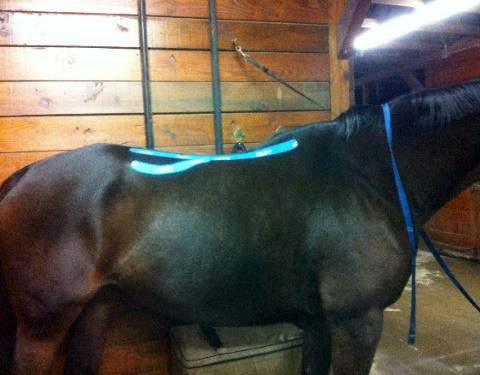 ASSESSMENT: Severe back pain from poor saddle fit, and hypotonic bilateral Longissimus muscles ASSESSMENT: Severe back pain from poor saddle fit, and hypotonic bilateral Longissimus muscles
APPLICATION OBJECTIVE: Athletic and therapeutic. APPLICATION GOAL: Strengthen muscle and reduce pain APPLICATION TECHNIQUE: Single strips applied for muscle facilitation CONSIDERATIONS: Horse to remain in work, tape remaining on until it comes off; re-evaluate in one week, and apply Equitape as needed. Call with any questions. No contraindications. |
|
|
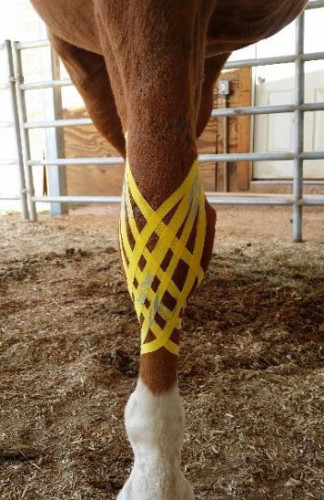 ASSESSMENT: Right front leg is swollen at carpus from blunt trauma – likely a kick from another horse. Area is swollen, warm and painful. ASSESSMENT: Right front leg is swollen at carpus from blunt trauma – likely a kick from another horse. Area is swollen, warm and painful.
APPLICATION OBJECTIVE: Therapeutic to speed recovery from injury APPLICATION GOAL: Circulation to decrease swelling and inflammation in the area and increase the flow of blood and lymph. APPLICATION TECHNIQUE: 2 fan strips of 4 tails in basket weave pattern CONSIDERATIONS: Taping is over a very mobile joint that is difficult to wrap and poultice; taping done on a weekend when there will be limited experienced volunteers; leave on for 1-4 days if he will keep it on |
|
|
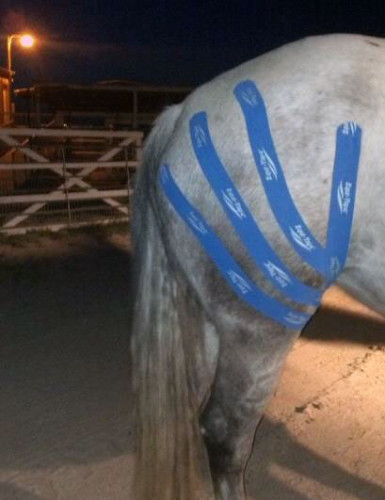 ASSESSMENT: Chronic right stifle effusion after improper trimming and shoeing while in training; shoeing has been corrected and chiropractic/body work has been done but effusion and discomfort persists ASSESSMENT: Chronic right stifle effusion after improper trimming and shoeing while in training; shoeing has been corrected and chiropractic/body work has been done but effusion and discomfort persists
APPLICATION OBJECTIVE: Therapeutic – rehabilitative to assist in healing APPLICATION GOAL: Decrease effusion and pain, improve mobility through improved biomechanics of the stifle joint APPLICATION TECHNIQUE: Multiple single muscle assist strips for CONSIDERATIONS: Horse will be in turnout with other horses, may need re-taped if it comes loose or is removed by horses; re-check in 4 days |
|
|
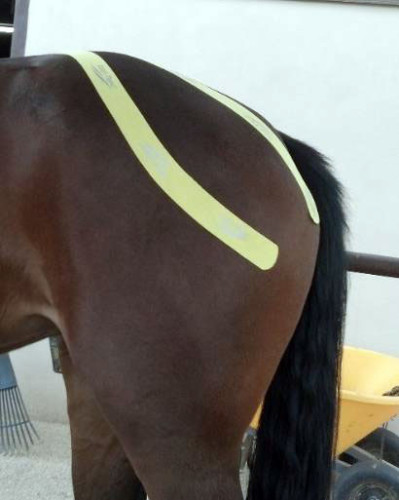 ASSESSMENT: Disuse atrophy of the left gluteal muscles from chronic injury and chiropractic issues ASSESSMENT: Disuse atrophy of the left gluteal muscles from chronic injury and chiropractic issues
APPLICATION OBJECTIVE: Athletic training to assist weak muscles after chronic disuse APPLICATION GOAL: Improve strength in the left hind through strengthening the gluteal muscles APPLICATION TECHNIQUE: 2 single strips in muscle assist pattern over the gluteal muscles and fascia CONSIDERATIONS: Horse is an eventer in training; can train with tape; leave tape with owner (who is a veterinarian) to be re-taped in 3-5 days and repeated as needed |
|
|
| Case Studies Reference Guide |